

The once and future Avaloch
The hotel is returning to its original name — which, for at least a millennium, has been impossible to spell consistently

I first visited the inn on Friday, January 5, 2024, when it was still owned by the Khaghans and Claire was considering making an offer. The bar and restaurant had been shut down; I saw only the caretaker, no guests. Claire, Danny, Joe and I sat around a roaring fire in the inglenook in the dormant Ostrich Room and talked about what Claire should call her new business.
The big one I scrawled atop my notebook page was “Claire’s Place”, which I think came from Danny. We liked its blunt lack of pretense, and it was what we were already saying. Or “Claire’s Lenox Inn”. We could distinguish the two buildings: “Claire’s House and Lodge”, or “Ostrich House and Lodge”. “Inglenook”? “Andiron”? “The Ordinary Inn”? Claire said an old house on the property was once called “Hawthorne Hill”; Hawthorne had accidentally named Tanglewood, and had also gone to Bowdoin. We talked about combing the Arlo Guthrie and James Taylor catalogs for inspiration, but that felt disingenuous to Claire: “I’m not a music person.”
It was a foregone conclusion that she would not keep “Apple Tree Inn”. In that group, it was barely discussed.
At that point it still felt insane that Claire’s dream was becoming real. Everyone had a lot of ideas and everything felt possible. But once the dream is real, you have real problems, and the ideas hibernate. She assumed control and continued operating under the existing name, but she never liked it and never faltered in her conviction to change it. It was too common and too cute.
But it would be hard to replace it with something that felt right. In her Starwood job, Claire got to see how big condo developments get named. The usual formula seems to be that you hire a consultant, they dig up the name of the third most obvious cool cultured dead person associated with the neighborhood, and they slap a definite article on the front of that person’s given name: “The Mathilda,” “The Clarence”, “The Judy”, that sort of thing. And then you pay the consultants a large fee. That experience developed antibodies in Claire that attack the lazy formulaic approach. But that meant nothing felt good enough.
Even as early as that Friday around the fire, a leading candidate was “Avaloch”, which Claire had already learned was the hotel’s former name. (I wrote it down with “The” struck through.) We had no clue what it meant, but it had a certain ring to it. And who could argue with going back to the past?
In early June of 2024, Christian found a bag of memorabilia in the basement. For Claire, who had spent untold hours in the library chasing every crumb of history, you could say it was like the Holy Grail. She showed me this, and our eyes lit up:
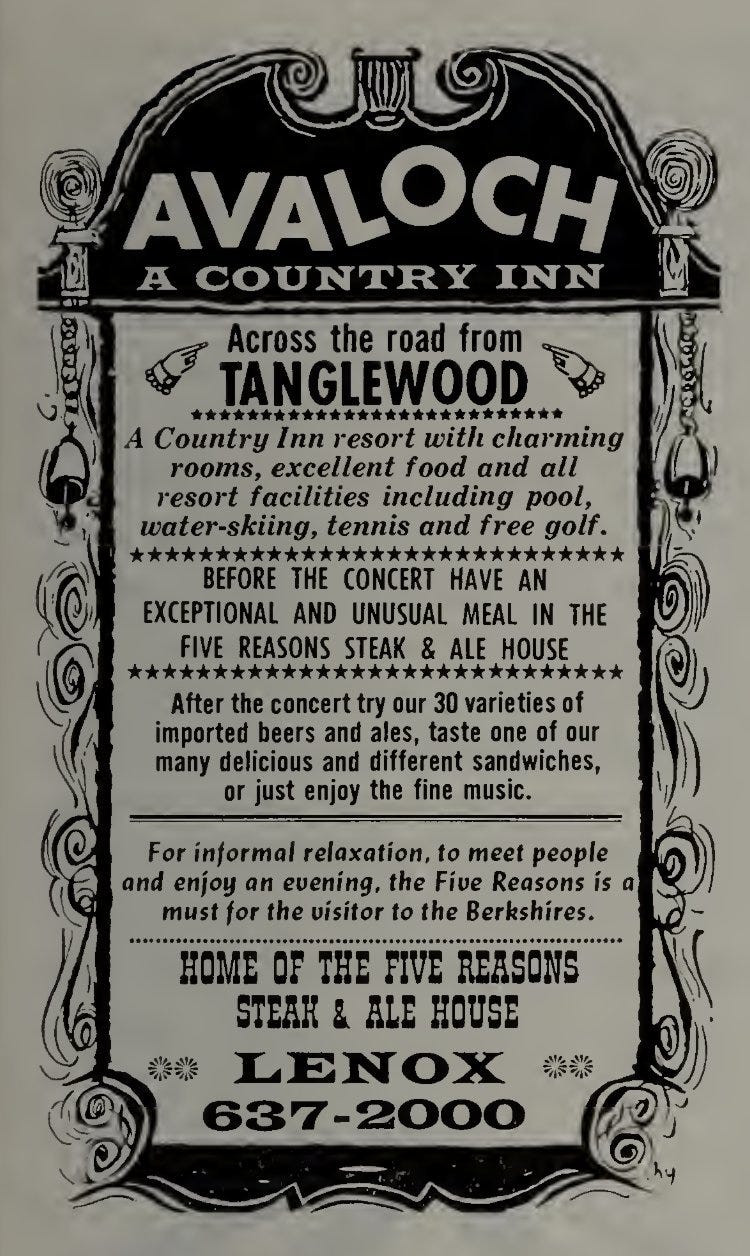
We were especially drawn to the wordmark. It felt contemporary. It had a bold silhouette. It had gravitas. It felt less accessible and more respectable. You could immediately see it was a bit zany, but it also seemed to respect some internal logic:
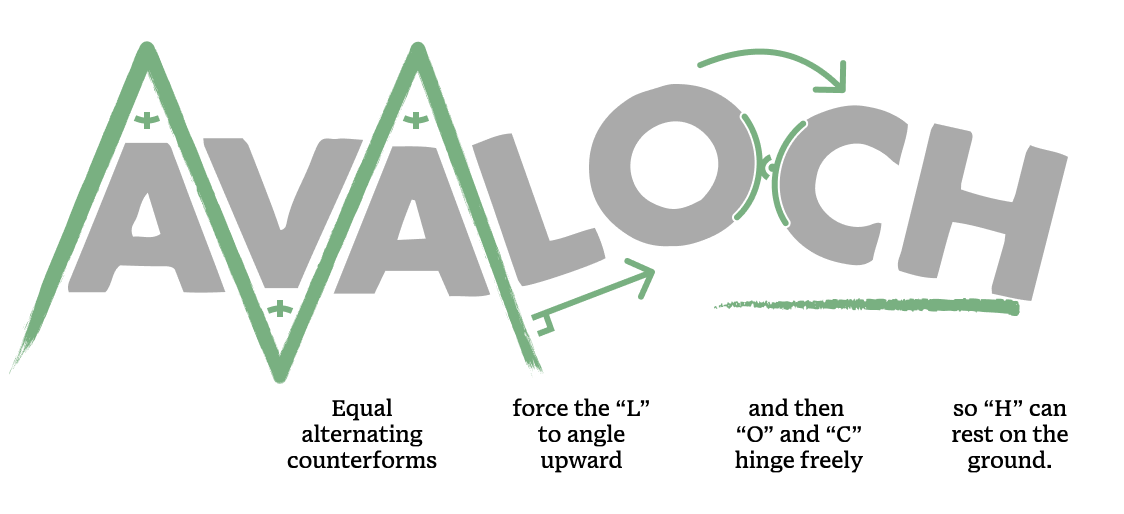
Maybe we didn’t have to change a thing; we could just go back to that.
In early 2025, our friend Larry Buchanan did a series of design explorations around that wordmark. He did a nice little trace, not too tidy, not too sloppy. We said “Should we at least try exploring a couple other avenues?”, but what we had was too solid. Imagine a kind of grooved game board with puzzle pieces resting atop in a jumble; as you shake the board, the things that fit stop moving. The wordmark was locked in.
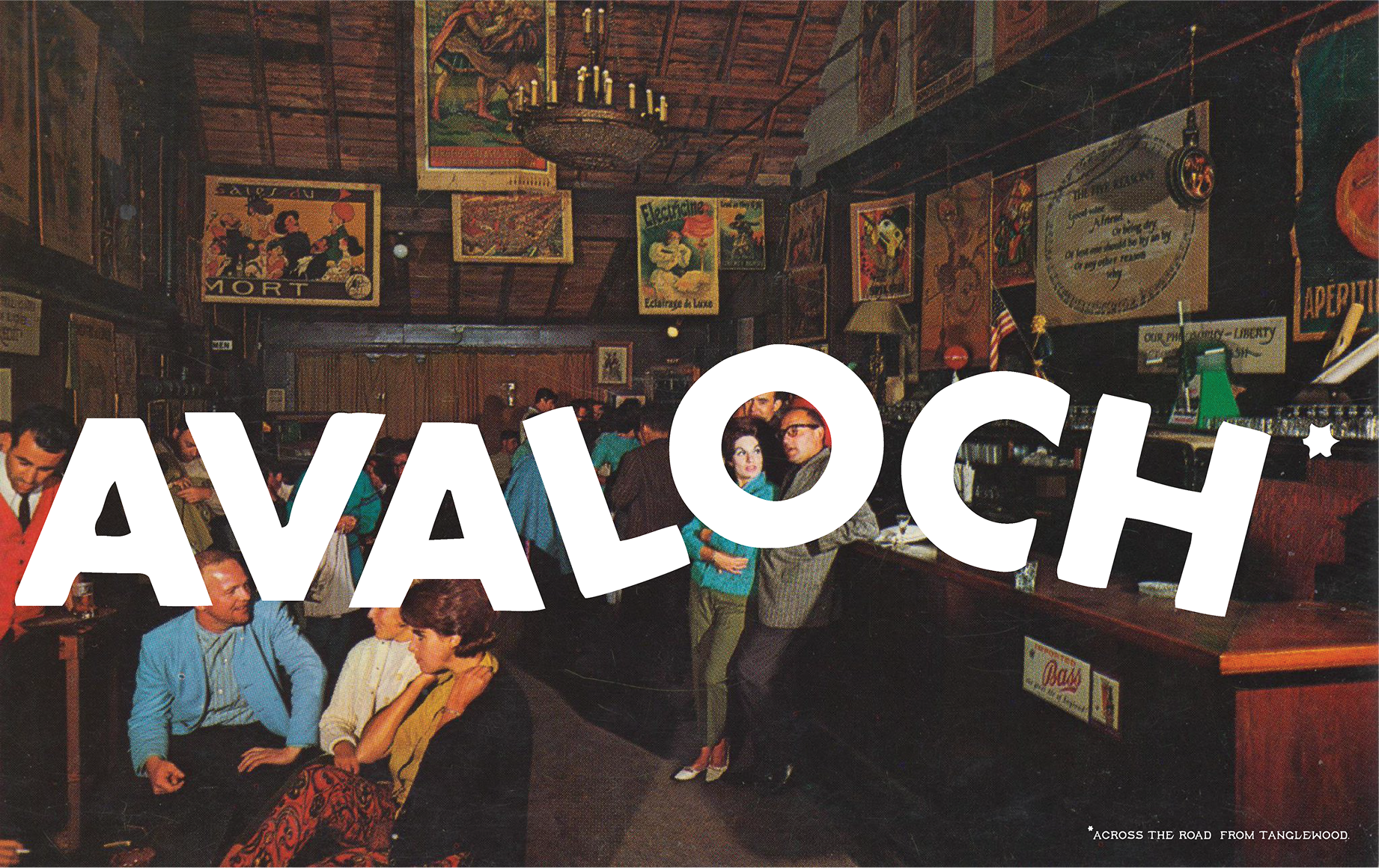
What really helped was seeing some applications. Logo on a photo! Logo on a menu! Logo with a tagline!
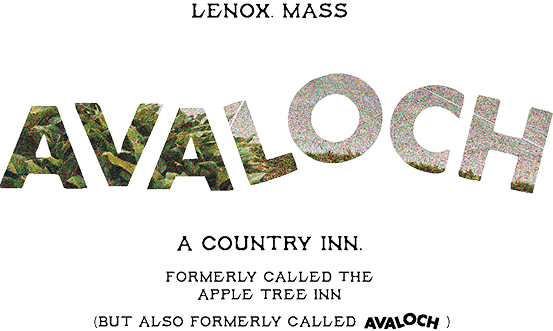
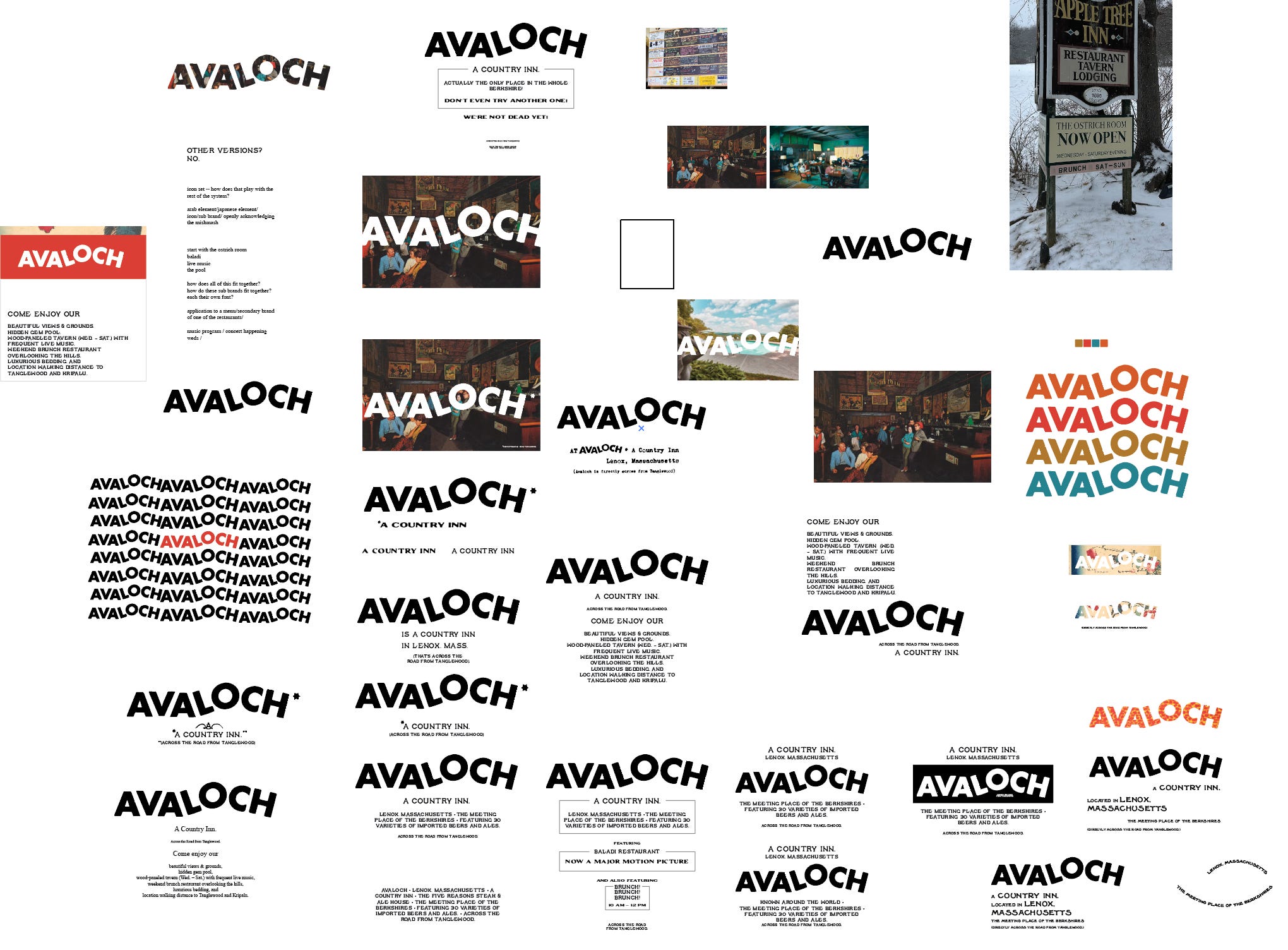
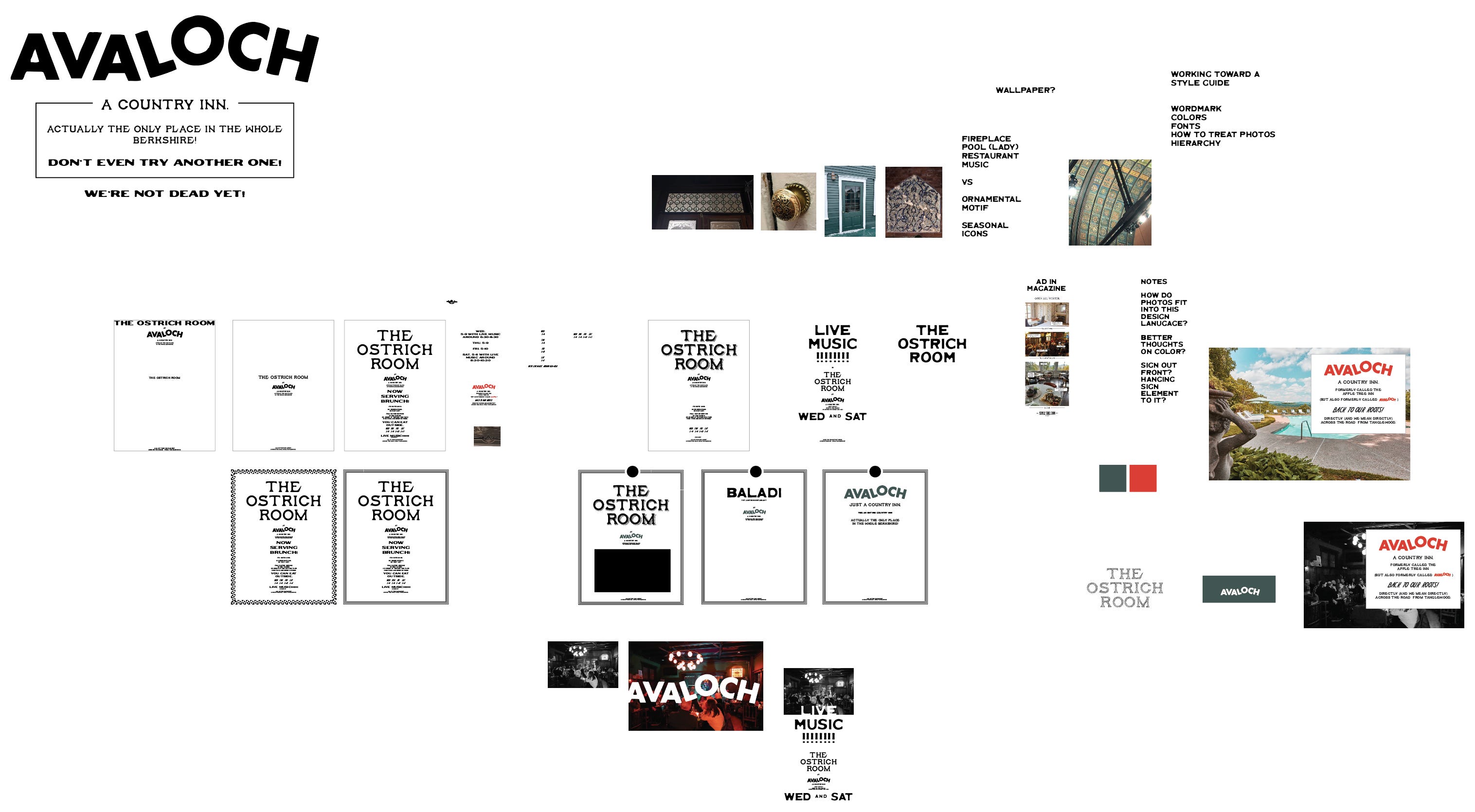
Once language got involved, we found that Larry had a natural voice for the job, like he had been a rustic inn in a past life and could channel that “voicefulness… which we feel in walls that have long been washed by the passing waves of humanity”. He had a knack for seizing on something Claire said offhand that “said it all”.
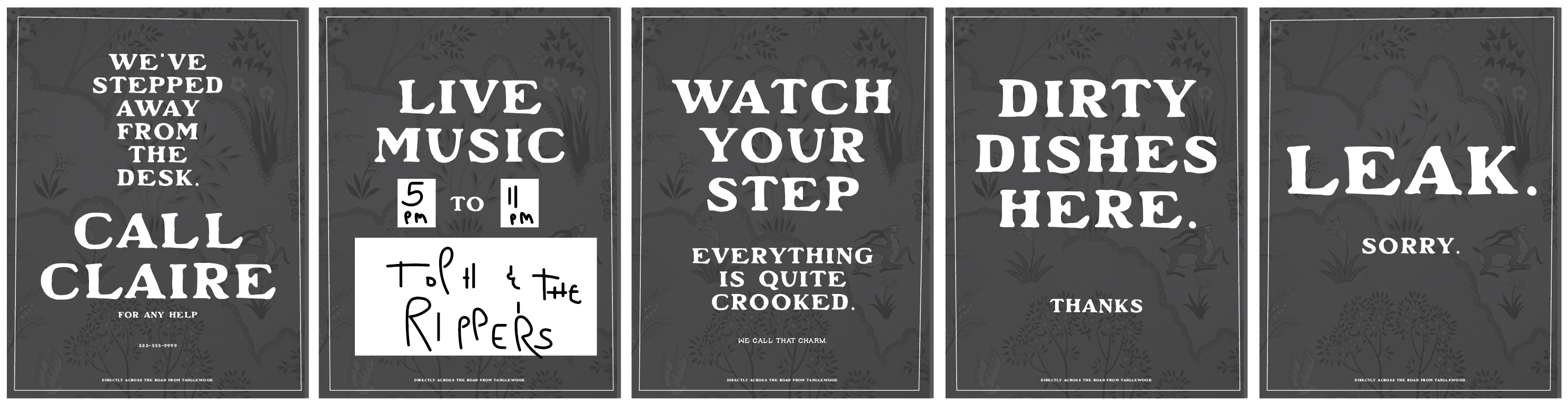
We’re always yammering on about Tanglewood across the street, so he made this footer the law of the land:
Or used it like a horizontal rule:
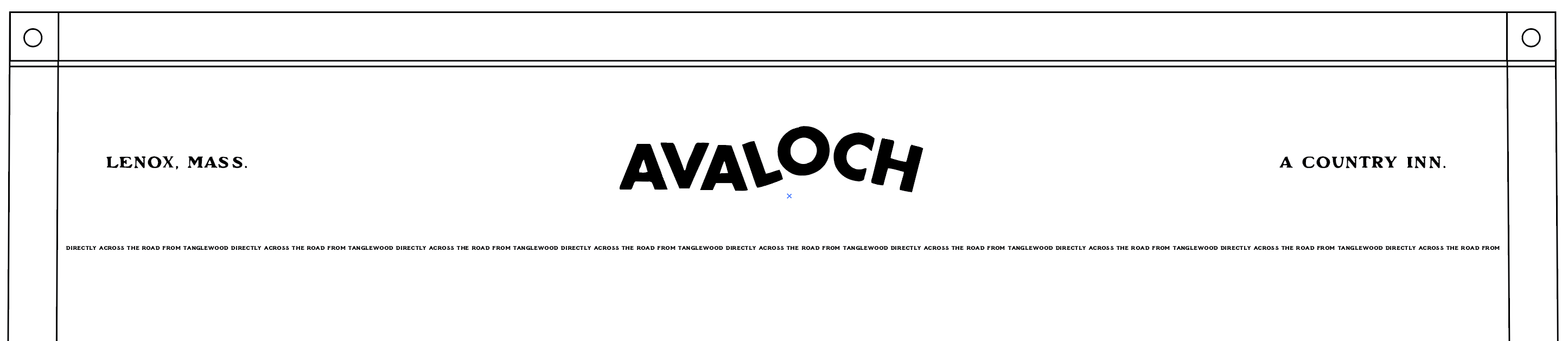
The building’s floors and walls and doors are often crooked, so the frame is too:

A good artist can compress a subject to very few pen strokes; I’ve been loving @riposhima on Twitter. Larry could sum up hours of “vision” in a few pithy words, freezing motifs into phrasemes.
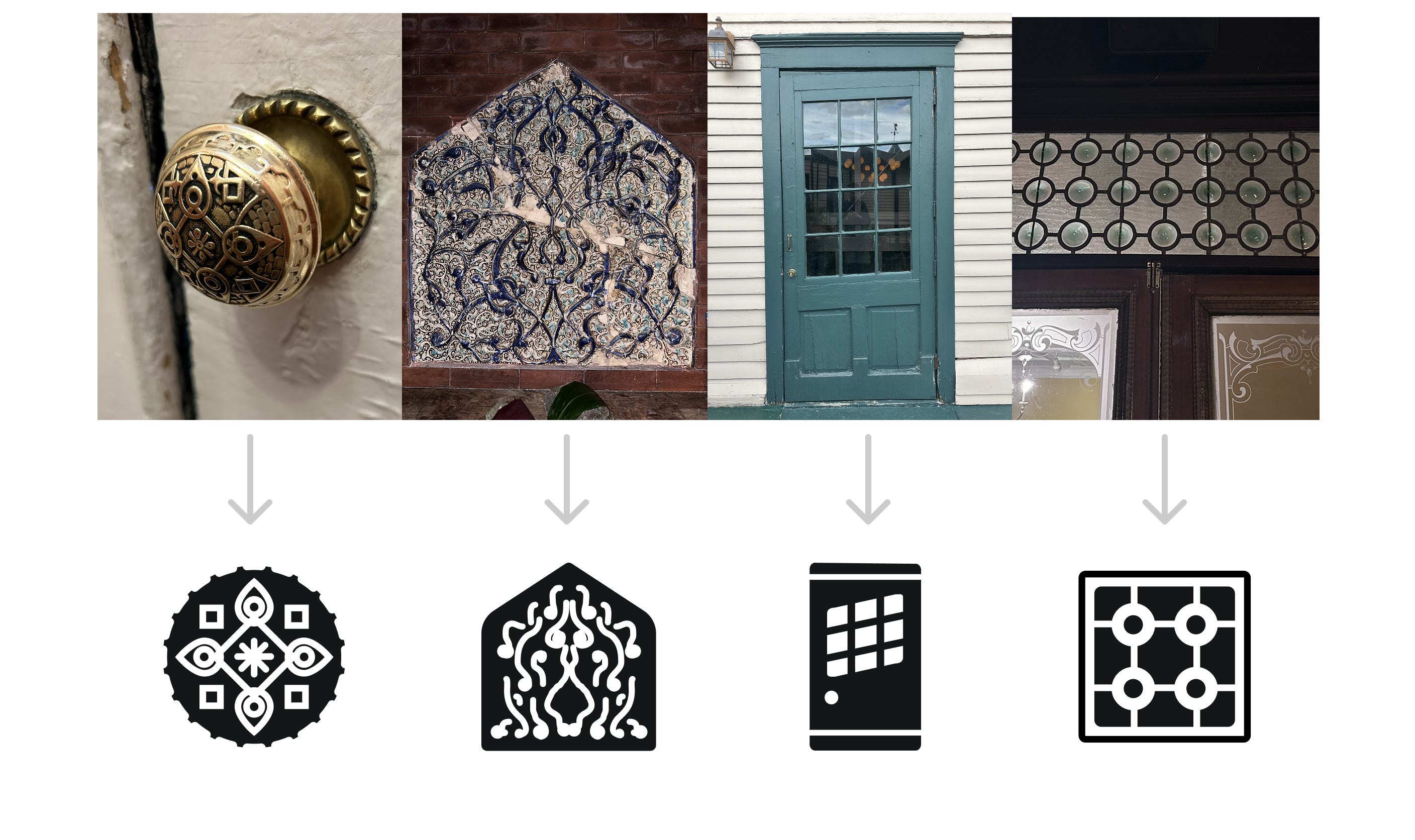
Larry brought on his brother Squid, which made our Google Meets a proper family affair. He started drawing little icons inspired by different ornamental architectural flourishes around the building:
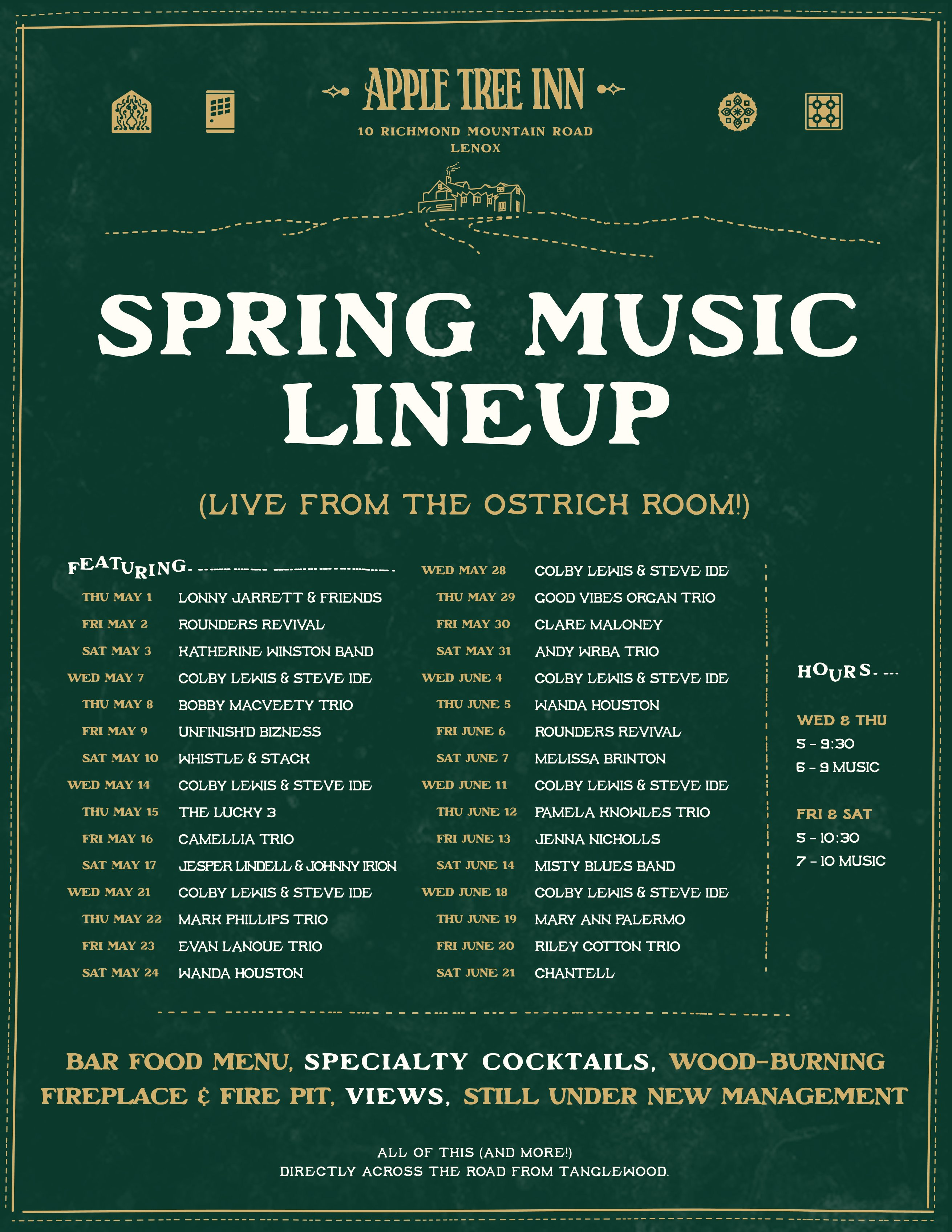
He then back-ported our Avaloch thinking to flyers for our live music, which we plastered around town last year, the first trace of any professionalism in our design:1
We were trying to eschew minimalism, to seek out some kind of ornamentation. But we didn’t make it easy for Larry and Squid. The property is structurally eclectic and we were drawing on scattered history. Bip articulated the sharpest critique: the logo is vintage, but not in the way the building is vintage. The logo is 1960s; the building is 1880s. It’s not the “mod” motel you’d expect from the logo. (The lodge sort of wants to be, but also still isn’t.) This was the toughest challenge to our beloved wordmark. We would have to somehow make the connection between the space and the brand. If we were going to be calling back to the ’60s, we should be calling back to the 1800s as viewed through the lens of the ’60s.2
As if that weren’t complicated enough, we talking to Larry and Squid from our month in Japan, where we were ostensibly researching onsen for the inn’s putative future spa. We wrote to them:
Claire listed some of the many competing directions you might’ve noticed (for the whole hotel, not just brand) in the air right now:
Fun pine green Adirondacks summer camp
Cool ’50s / ’60s mod lodge
Late 1800s gilded age
Japonisme aestheticism
Traditional New England colonial saltbox
English arts & crafts
Of those, she wants to focus on synthesizing the ’50s / ’60s heyday (for its graphics and social / intellectual vibrancy) and aestheticism (for its old-timey maximalist globalized eclectic interiors). Can it be done?! We’ll find out!
Though we were trying to be self-aware, Larry and Squid still laugh about it to this day.
We settled on using the inn’s ornamental wallpapers diffused through rich jewel tone colors, and prepared a brand deck to present to the staff.
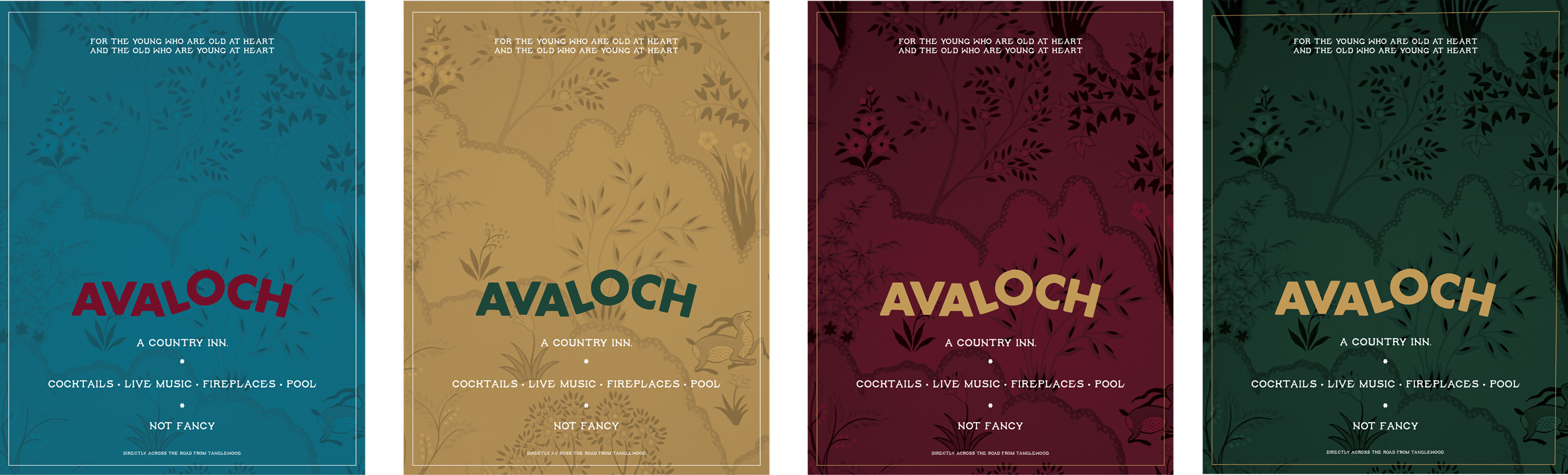
Not fancy. That was one of those things Claire said offhand that Larry rightly seized on.
I sent it to Richard and he hated it. “Yeah it’s not good. Soon as you start to hit the brief on the nose and be exactly what it is you moodboard your way to a bad place. Hotels should be really simple and not try hard. Especially ones in the middle of the Berkshires. Look personally, I would pick a typeface and force yourself to only use that one typeface. Don’t complicate it. Chose your materials carefully. Pay attention to what paper you print menus out on. Materials connote quality (more than design does often). And tbh I would try and ensure a designer doesn’t get near it. The charm of those references is their naivety. Their limitations. Maybe have a mascot?”
He cited chateaumarmont.com as an example of a good simple hotel website. But to Claire, Chateau Marmont has earned that level of understated minimalism; she hasn’t, and it looks pretentious to try. “Avaloch” doesn’t speak for itself. Nobody knows it. The respectful thing to do is to make a bit more of a pitch.
The fight now grew more furious than ever, and proved fatal to almost all the commanders and their forces. For on Modred’s side fell Cheldric, Elasius, Egbrict, and Bunignus, Saxons; Gillapatric, Gillamor, Gistafel, and Gillarius, Irish; also the Scots and Picts, with almost all their leaders: on Arthur’s side, Olbrict, king of Norway; Aschillius, king of Dacia; Cador Limenic Cassibellaun, with many thousands of others, as well Britons as foreigners, that he had brought with him. And even the renowned king Arthur himself was mortally wounded; and being carried thence to the isle of Avallon to be cured of his wounds, he gave up the crown of Britain to his kinsman Constantine, the son of Cador, duke of Cornwall, in the five hundred and forty-second year of our Lord’s incarnation.
—trans. Aaron Thompson and J. A. Giles, 1848
Geoffrey of Monmouth’s Historia Regum Britanniae (“History of the Kings of Britain”), written around 1136, was once thought to be history but is today considered to be something more like literature. It mentions the island of Avalon twice: as the place where Excalibur was forged, and as the place where King Arthur was taken to nurse his mortal wounds.
Geoffrey expanded on the latter in Vita Merlini (“Life of Merlin”), circa 1150:
“The Island of Apples gets its name ‘The Fortunate Island’ from the fact that it produces all manner of plants spontaneously. It needs no farmers to plough the fields. There is no cultivation of the land at all beyond that which is Nature’s work. It produces crops in abundance and grapes without help; and apple trees spring up from the short grass in its woods. All plants, not merely grass alone, grows spontaneously; and men live a hundred years or more.
“That is the place where nine sisters exercise a kindly rule over those who come to them from our land. The one who is first among them has greater skill in healing, as her beauty surpasses that of her sisters. Her name is Morgen,3 and she has learned the uses of all plants in curing the ills of the body. She knows, too, the art of changing her shape, of flying through the air, like Daedalus, on strange wings. At will, she is now at Brest, now at Chartres, now at Pavia; and at will she glides down from the sky on to your shores…
“It was there we took Arthur after the battle of Camlan, where he had been wounded. Barinthus was the steersman because of his knowledge of the seas and the stars of heaven. With him at the tiller of the ship, we arrived there with the prince; and Morgen received us with due honour. She put the king in her chamber on a golden bed, uncovered his wound with her noble hand and looked long at it. At length she said he could be cured if only he stayed with her a long while and accepted her treatment. We therefore happily committed the king to her care and spread our sails to favourable winds on our return journey.”
—trans. Basil Clarke, 1973
You might infer that Arthur died there, but the legends do not describe Arthur’s death. Even Sir Thomas Malory’s 15th-century Le Morte d’Arthur, despite the title, says he can only find evidence that Arthur was taken away on a ship. “Some men yet say in many parts of England that king Arthur is not dead,” writes Malory, “but had by the will of our Lord Jesu Christ into another place; and men say that hee will come againe, and he shall winne the holy crosse. I will not say that it shall bee so, but rather I will say that heere in this world hee changed his life. But many men say that there is written upon his tombe this verse: ‘Hic jacet Arthurus, rex quondam, rexque futurus’” — hence T. H. White’s 20th century collection, The Once and Future King.
In Geoffrey’s original Latin, in the first text, he called the island “Insula Avallonis”, and in the latter, “Insula Pomorum”. They’re translated above as “Isle of Avallon” and “Isle of Apples”. But in fact both the Celtic “Avallonis” and the Latin “Pomorum” can mean either apple or fruit.4
“Pomorum” comes from Latin “pōmus”, apple or fruit (tree), from which we get the French “pomme”, apple, and “pommier”, apple tree, as well as the English “pomegranate”.5 Similarly, the Old Welsh, Old Cornish, Old Irish, or Old Breton “aball” or “avallen” or “afal” or “abalnā” could also mean either apple or fruit (tree). From the same root we get the English “apple”, the Russian “яблоко”, and the Latvian “ābele”.
Afallach or Aballac is a Welsh name traced back to the son of Beli Mawr, a legendary cousin-in-law of the Virgin Mary. Some Welsh translations of Geoffrey thus called the island “Ynys Afallach”. William of Malmesbury connected the island to a man Avalloc; Gerald of Wales connected it to a man Avallo. Geoffrey was synthesizing centuries of folklore, and may have been inspired by the Irish apple island paradise Emain Ablach, home of the sea god Manannán, sometimes identified with the Isle of Man.
My crude and cursory understanding is that the land we call Britain had first the native Celts, and then the conquering Anglo-Saxons, and then the conquering Normans. Arthur was a Celt resisting the Anglo-Saxons, circa 500; when Geoffrey was writing in 1136, the Normans were conquering both Celts and Anglo-Saxons. The Normans had taken England and were pushing west into Wales. Geoffrey’s revival of the Arthurian legend served both the Norman purpose of having a united kingdom to claim and the Welsh purpose of resisting that claim.
Glastonbury is sometimes thought to be the true site of Avalon. After the abbey there burned in 1184, an excavation in 1191 claimed to discover two bodies buried under an oak tree beneath a lead cross inscribed “Hic jacet sepultus inclitus rex Arturius in insula Avalonia”. Today, historians suggest it was either a tourism stunt or propaganda against the idea of the future king. The Normans did not want the Welsh expecting a savior. The Church was awaiting only one messianic return.
None of these quite match our spelling of “Avaloch”, which must have been chosen by Roy Rappaport when he converted the property to an inn in 1952. We have found no written explanation from him. He died in 1997; his wife Ann died on March 6, 2023. Shortly thereafter, as Claire considered the property, she met with the Rappaports’ daughter, Mimi, who told Claire about the Arthurian inspiration.
After Rappaport sold the inn to pursue anthropology, the property changed hands a few times before landing with Michael Bakwin. We owe Rappaport the name, but we owe Bakwin the wordmark. (We have no idea who did it, but I hope reviving it will draw them out of the woodwork.) It changed hands a couple more times before landing with Alice Brock, who ran it as “Alice’s at Avaloch” — an incarnation many in town still remember fresh and fondly. When we met her, just before she died, Claire told her she was going to change the name back, which Alice seemed to approve of.
When we asked Alice what “Avaloch” meant, she said “over the lake”. We do have a great view of the Stockbridge Bowl — and it would have been even better in their day, with fewer trees! Maybe our Arthurian reference just has its spelling rounded off to the nearest lake reference.6
We had dropped a couple references to changing the name over the last few months, but we posted Claire’s main announcement to Instagram on March 1. The music is the beginning of an aria from Henry Purcell’s 1691 opera King Arthur, “What power art thou?”, sung by the spirit of winter awakening. A guest tagged Mimi, who commented — to our delight and relief — “I so agree with you about how Apple Tree Inn sounds generic, and Avaloch sounds… somehow mysterious, dignified, vintage, all the things. Thanks for honoring our dad’s legacy — he would be thrilled!!” We’ve heard nothing but praise, though in person we get a lot of “Huh?” and “Wha?” and “Avalon?” and “Spell that?”
Many tasks remain. We have transfer our domain and update our Google Maps listing. We’re working on a new road sign.
The spelling is just barely common enough that “Avaloch” is taken in most namespaces. On Instagram, @avaloch is a person we haven’t been able to get in touch with, so we’re @avaloch.inn. On the web, avaloch.com is Avaloch Insurance, based in Ontario, which has been online since at least 2010, so we’re avalochinn.com. We’ve chatted with them on the phone; they’re very friendly, and we certainly recommend them for all your insurance needs!7
There are over two hundred results for “Avaloch” on archive.org. Several copies of an Arthurian story in Portuguese; a recording of “Lute Songs of John Dowland and His Contemporaries” crediting the farm institute; the 2012 Town of Boscawen Annual Town Report citing the construction of the farm institute; a reference to “a children’s fantasy series entitled William Avaloch”. A book of Celtic tree mysteries and a book of Celtic magic both transcribe the pronunciation of “Abhlach” as “avaloch”.
But — incredibly — the vast majority of the results seem to be for us, for this one, for our Avaloch.
There are old advertisements in Boston Symphony Orchestra programs, the Saturday Review of Literature, National Coin Investor, High Fidelity, and local yearbooks. The June 1954 Music Journal noted an upcoming “festival… devoted to medieval, renaissance, and baroque music” at Avaloch. A history of Lenox estates noted that The Orchard (our main house) and Bonnie Brae (demolished) became part of Avaloch. “How to reach anyone who’s anyone” said where to find Alice, probably to her chagrin. Barbara Ann “Legs” Frye, Pittsfield High class of 1955, listed her hobbies as “Music, children, Avaloch”.
In 1955, a Notre Dame student named Raymond C. Kennedy adapted his experience as a camp counselor to the short story “Nightcrawlers”:
At the last note of taps all was quiet along the row of gray cabins. Down at the wash house a few of the counselors were showering and shaving, getting ready to go out for the remainder of the evening. John walked in.
“Hi, Bert. Where are you guys going tonight?”
“Just drinking, I guess.” Bert was combing his hair.
“Where ’bouts?”
“Up Avaloch.”
“Where’s that?”
“Haven’t you ever been up there before?”
“No. What is it, just a bar?”
“No, it’s a resort hotel like Springdale only much better. Lots of stag girls up from the city.”
Later:
“Say, Leo, where is Avaloch?”
“Oh, haven’t you ever been there before? Go down this road for about a mile. It’s up on a hill all lit up. You can’t miss it.”
“Thanks, Leo.”
“Sure thing.”
The bar at Avaloch was quite crowded when John walked in. He recognized a group of the counselors at a table in the rear and began to make his way through the crowd. Before he reached the table though, Jerry, the tennis counselor, reached out from his position at the bar and pulled John in.
That must be us, right? It’s gotta be. What a thrill!
I mean… “us”. This place. The onetime Avaloch. Can we call that “us”? We just got here!
Every previous owner of this property either kept the name and branding or changed it to something new. We, however, are going back. In fact, we’ve now gone back twice: from the Khaghans’ “Apple Tree Inn” logo to one derived from the older street sign; and now, back to Avaloch.

Is this reactionary? Revanchist? We seek a restoration after an interregnum. We want to revive a certain spirit. We are making a claim at a kind of continuity; by honoring the Avaloch era, we hope that some of its honor will reciprocate, and spill back over to us. We are saying that we believe we are aiming at something in accord with what they were aiming at, and accepting the responsibility of doing justice to it. When Rappaport writes in a magazine ad, “there is a hard-to-define élan derived, perhaps, from an elegance that doesn’t take itself seriously, and from an attitude toward people’s needs which does”, it speaks to us. Not fancy.
In Historia Regum Britanniae, Arthur sweeps across Europe to the brink of taking Rome itself until he is betrayed by his nephew. That never happened — or, you could say, it did not happen for another fifteen hundred years, until Sir Harold Alexander’s forces took Rome on June 4, 1944. Geoffrey of Monmouth developed the real future unity of Norman Britain by positing a fictitious past unity. When we regale you with tales of Avaloch past, when we assemble our framed photos and history exhibits in the hotel hallways, we are constructing our own myth.
When I examine my own delight at returning to the original name, some contrarian spirit reminds me that Jacques Barzun defined a period of “decadence” as one in which “[t]he forms of art as of life seem exhausted, the stages of development have been run through.… Repetition and frustration are the intolerable result.” Does a return imply we can no longer believe we can build a brand better than the past could?
Fortunately, that anxiety is counterbalanced by my inverse anxiety about the rest of the renovation.
Claire tore down the round room around the same time Trump tore down the East Wing of the White House, and she received a lot of wisecracks about the coincidence. There is something there, to the credit of both of them. Whether I ran this inn or this nation, I don’t know if I could ever bring myself to touch either building. How could I ever understand why the past did what it did? Surely we can’t do it as well as we once did! Every market looks too efficient; every fence looks too Chestertonian. But that attitude is disastrous. I free-ride on the gall of those brazen enough to dare think they can make something better.
The brand goes back. The building goes forward.
Rory said “it looks like the Irish soap ad,” with a screenshot of Irish Spring.
I think this point was inspired by the extraordinary documentary ¡Casa Bonita Mi Amor!, about Trey Parker and Matt Stone reviving the Casa Bonita restaurant as a pastiche of frontier Mexico viewed through the lens of the 1970s. Claire similarly loves the layering of how Dishoom is Iranian food, through the lens of midcentury Bombay, brought to London. And she loves to think about the graffiti left on the pyramids by the ancient Greeks.
The recurring ambiguity between “apple” and “fruit” has theological consequences. There is another Latin word for either apple or fruit: mālum, with a long ‘a’, from the Greek mālon — which sounds an awful lot like mălum, with a short ‘a’, which means ‘evil’ or ‘bad’. Genesis 3:6 mentions only a fruit, not an apple, throughout the Hebrew Bible (פְּרִי), the Septuagint (καρπός), Jerome’s Vulgate (fructus), the King James Version (fruit), and so on. But it is speculated that the pun between mālum and mălum skewed Western art toward interpreting the fruit as an apple. In the illuminated Moutier‑Grandval Bible, circa 840, Eve reaches for a dark round fruit. By the time of Albrecht Dürer’s 1507 “Adam and Eve”, it’s clearly an apple. In contrast, some Talmudic and Islamic commentaries hold the forbidden harvest to have been wheat.
There was another former Apple Tree Inn in Indianola, Iowa that rebranded to “Hotel Pommier”, and the guy who did it has a great Twitter account. Maybe it’s the arc of all Apple Tree Inns to rebrand to a kind of Straussian apple tree.
Our town of Lenox is thought to be named after Charles Lennox (1735 – 1806), who supported American independence and was the 3rd Duke of “The Lennox”, a historic province of Scotland around Loch Lomond, including Mackintosh’s Hill House, which roughly coincides with the modern county of Dunbartonshire. When our town was being incorporated, a clerk misspelled his name.
On Twitter, it’s a different person who may live in town whom we should really track down. There’s also the Avaloch Farm Music Institute in New Hampshire, which we haven’t yet reached out to, but which I’m sure we’d recommend for all your arts retreat needs!
Yes!! But how do we address it-- literally? Dear A H
V L C
O A I'd like to book a room
The brand goes back. The building goes forward. Long live Japonisme aestheticism. Where have you landed on Richard's feedback? Are you scrapping the wallpapers? I love how the logo looks on the old drawing of the Ostrich room.